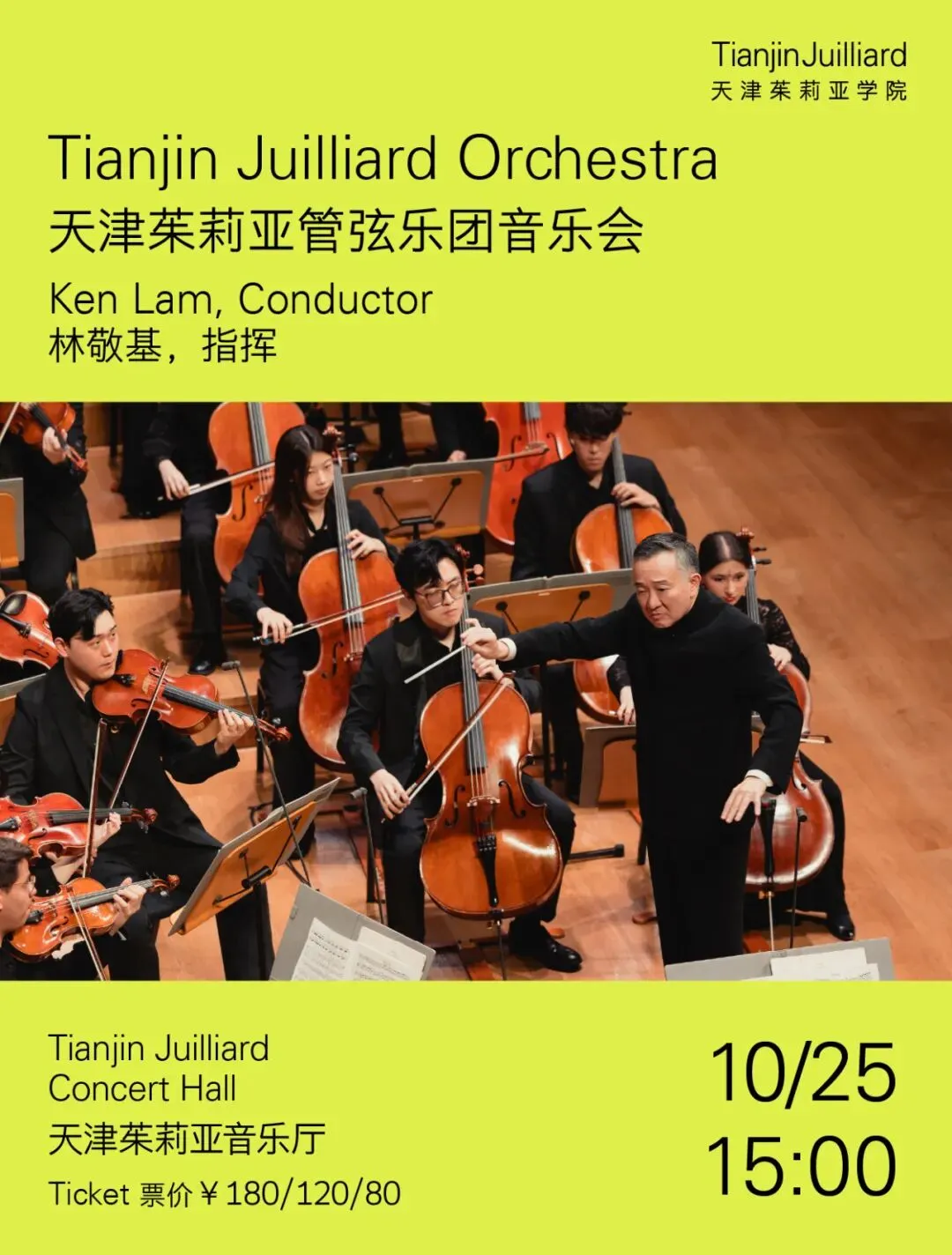
本周日,天津茱莉亚管弦乐团将在驻团指挥林敬基(Ken Lam)的带领下呈现本乐季第二场音乐会,演绎贝多芬《C小调第五交响曲》、巴伯《第二管弦乐随笔》,以及选自伯恩斯坦《西区故事》中的“交响舞曲”。
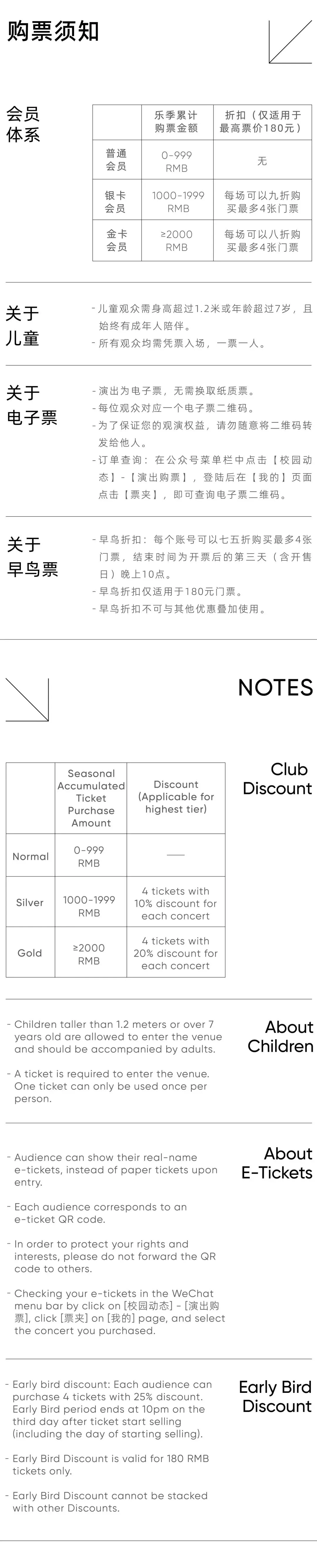
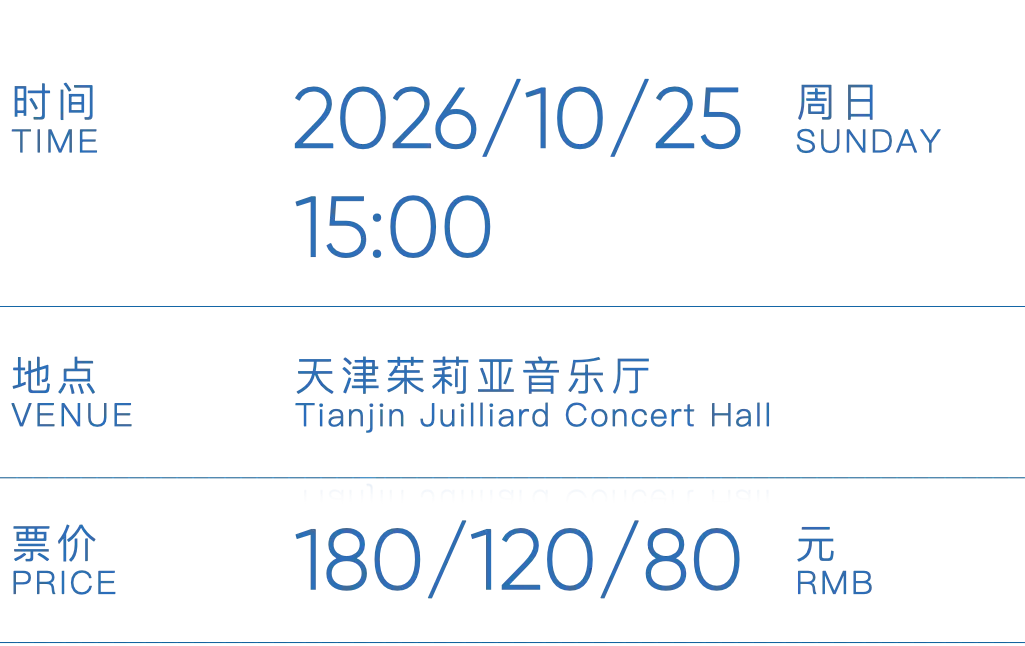
本场音乐会为售票演出,观众可扫描下文中的二维码进行购票。购票观众可于当日14:00前往天津茱莉亚演奏厅参加由音乐理论教师王乐游带来的音乐会导赏,并可于演出前免费体验“茱莉亚幻想空间”。
天津茱莉亚管弦乐团音乐会 Ⅱ
TIANJIN JUILLIARD ORCHESTRA CONCERT Ⅱ
林敬基,指挥
Ken Lam, Conductor
演出曲目
PROGRAM
路德维希·范·贝多芬(1770-1827)
C小调第五交响曲,作品67
Ⅰ. 充满活力的快板
Ⅱ. 稍快的行板
Ⅲ. 快板
Ⅳ. 快板
LUDWIG VAN BEETHOVEN (1770-1827)
Symphony No. 5 in C Minor, Op. 67
Ⅰ. Allegro con brio
Ⅱ. Andante con moto
Ⅲ. Allegro
Ⅳ. Allegro
中场休息
INTERMISSION
塞缪尔·巴伯(1910-1981)
《第二管弦乐随笔》,作品17
SAMUEL BARBER (1910-1981)
Second Essay for Orchestra, Op. 17
伦纳德·伯恩斯坦(1918-1990)
交响舞曲,选自“西区故事”
Ⅰ. 序幕(中庸的快板)
Ⅱ. 在某处(柔板)
Ⅲ. 谐谑曲(活泼而轻巧地)
Ⅳ. 曼波舞曲(稍快的急板)
Ⅴ. 恰恰舞曲(优雅的行板)
Ⅵ. 相遇场景(稍慢)
Ⅶ. 冷静赋格(小快板)
Ⅷ. 火拼(甚快板)
Ⅸ. 终曲(柔板)
LEONARD BERNSTEIN (1918-1990)
Symphonic Dances from “West Side Story”
Ⅰ. Prologue (Allegro Moderato)
Ⅱ. Somewhere (Adagio)
Ⅲ. Scherzo (Vivace e leggiero)
Ⅳ. Mambo (Meno Presto)
Ⅴ. Cha-cha (Andantino con grazia)
Ⅵ. Meeting Scene (Meno mosso)
Ⅶ. Cool Fugue (Allegretto)
Ⅷ. Rumble (Molto allegro)
Ⅸ. Finale (Adagio)
演出曲目以现场演奏为准
The program is subject to change
路德维希·范·贝多芬
C小调第五交响曲,作品67
LUDWIG VAN BEETHOVEN
Symphony No. 5 in C Minor, Op. 67
作为古典主义与早期浪漫主义时期的重要人物,贝多芬的音乐往往表现出强烈的情感、冲突,以及克服困难的挣扎。这些特质在他创作生涯中期的“英雄时期”尤为鲜明,《第五交响曲》正是这一时期诞生的作品。同时,也是贝多芬重要艺术成就中最著名的例子之一:整部作品从极其简练的音乐素材出发,不断孕育、发展,最终汇聚成一股磅礴的力量。开头的动机仅由四个音符组成(而这四个音堪称音乐史上最著名的音符之一)。但贝多芬不断让这一四音素材重新出现,并改变它出现的位置与声响。它可以是由弦乐与管乐演奏的主角;也可以是音乐背景的一部分。通过这种方式,这颗微小的音乐种子逐渐生长,似乎始终驱动着音乐持续向前。
第二乐章传递出截然不同的氛围。它较为缓慢也更加温暖,主要主题平和而宁静,但并未完全摆脱第一乐章的张力。音乐通过节奏、力度与配器的变化持续发展。虽然这一乐章的大部分内容围绕降A大调的主要主题及其变奏构成,但C大调胜利的意象破势而出,却未能充分展开,便又消逝而去。整体而言,第二乐章宛如漫长旅程中的一座宁静之岛。
第三乐章回到C小调,笼罩在一种静谧而幽异的期待之中。尽管音乐较为柔和,其紧张感却与第一乐章同等强烈。接下来,迎来此交响曲最具戏剧性的时刻:当乐曲彷佛陷入停滞之际,突如其来的渐强将音乐推向C大调的爆发,第四乐章无缝衔接。随着短笛、长号与倍低音管的加入,贝多芬扩展了乐队的规模,以增强终曲的力量。声响瞬间变得更加明亮、响亮而有力。在经历了黑暗的C小调之后,这种向C大调的转变感觉像是一种胜利般的释放。尽管终乐章大部分篇幅洋溢着欢庆的气氛,但此前的四音素材依然存在,意味着先前的挣扎并未完全消逝:贝多芬以一种独创性的手法,在终乐章中重新引入谐谑曲的音乐材料,进一步将这两个乐章融合为一个更为宏大的整体。这一创举对随后一个世纪的音乐作品产生了深远影响。这部交响曲整体的戏剧性结构,呈现出一种从紧张与不确定逐步走向胜利与力量的进程。这部作品的非凡之处在于,一段史诗般的音乐旅程,竟源自如此微小的起点。
The major figure of what we know as the Classical and early Romantic periods, Beethoven’s music often shows strong emotions, conflict, and the struggle to overcome difficulties, particularly during the “heroic” middle period that birthed his fifth symphony. This work is the most celebrated example of one of Beethoven’s most notable artistic achievements: the whole work grows from very small musical ideas that undergo constant growth and development, finally become something of immense power. The opening motive consists of only four notes (albeit the most famous four notes ever set to paper). But Beethoven keeps bringing this four-note figure back, changing where it appears and how it sounds. It can be the main character played by the strings and winds, but it can also become part of the musical background. In this way, the small musical seed grows and seems to keep pushing the music forward.
The second movement delivers a very different atmosphere. It is slower and warmer, with a more peaceful main theme, but does not completely leave behind the tension from the first movement. The music continues to grow through changes in rhythm, dynamics, and orchestration. While much of the movement consists of variations on the A-flat major main theme, visions of C major triumph break through, only to pass away unconsummated. Overall, the second movement feels like an island of calm in the middle of a larger journey.
The third movement returns to C minor in a mood of hushed and eerie expectation. While the music is softer, the feeling of tension is as strong as in the opening movement. What comes next is the most dramatic moment of the symphony. After the music seems to get stuck, a sudden crescendo leads to a burst of C major, and the fourth movement begins without break. With the addition of piccolo, trombones, and contrabassoon, Beethoven makes the orchestra bigger to increase the power of his finale. The sound suddenly becomes much brighter, louder, and stronger. After the dark C minor music, this change to C major feels like a triumphant release. Even though most of the remainder finale is in a celebratory mood, the earlier four-note idea is still present, which means the feeling of struggle has not completely disappeared: in an original stroke that was to have reverberations throughout the works of the century that followed, Beethoven brings back the music of the scherzo during the finale, further fusing the two movements into a single larger design. The overall dramatic structure of the symphony suggests a movement from tension and uncertainty toward victory and strength. What makes the work remarkable is that this epic musical journey grows from such a small beginning.
曲目介绍由杨家鑫撰写
2027届管弦乐表演专业研究生,小提琴
Program notes by Jiaxin Yang
MM ’27, violin, Instrumental and Orchestral Studies
塞缪尔·巴伯
《第二管弦乐随笔》,作品17
SAMUEL BARBER
Second Essay for Orchestra, Op. 17
此曲创作于1942年,当时正值战争时期。实际上,就在完成这部作品后,巴伯随即加入了美国陆军航空队。作品并无特定的标题性构思,是一首抽象的单乐章管弦乐作品。不过,作品中所呈现的英勇而不屈的情绪,似乎确实与当时的时代氛围相契合。
作品标题中的“随笔”源自文学散文。一篇随笔通常围绕一个核心论点,从不同角度加以阐述、论证与拓展。巴伯将这种文学手法运用于音乐创作。整部作品围绕一个核心音乐构思展开,通过不断的变化与扩展逐步推进,最终走向宏大的结尾。这种创作手法有着悠久的传统,可以追溯至贝多芬。在巴伯的三首管弦乐随笔中,第二首的戏剧性最为强烈,配器也最为丰富。
乐曲以宁静的氛围开篇,长笛独奏在轻柔的伴奏中奏出柔和的旋律。巴伯不断地重新引入这一核心主题,并让它在不同乐器之间依次传递。时而由木管乐器与弦乐器承载;有时则隐入音乐的背景织体之中。这一不断重复、变幻的旋律,持续推动着音乐向前发展。
尽管第二主题带来了一些对比,但它并非全然崭新的素材,而是自然地从开篇的音乐素材中衍生而来。虽然音乐以流畅而富有表现力的旋律线条展开,但其潜在的张力却从未完全消散。全曲最具戏剧性的转折出现在中段的赋格段落,其中的音乐素材仍然源自开篇的旋律。随着多个调性与声部层层叠加,音乐彷佛一场正在酝酿的风暴。在这股动荡到达顶峰时,巴伯并未让这一段落得到明确的解决,而是逐渐减弱力度。即使音响渐趋微弱,音乐内在的张力仍未真正释放。当最后一段的铜管乐器骤然奏响时,开篇的主题再次由圆号与长号奏出,并由整个管弦乐队为其提供支撑。这种音乐构思展现了一段历程:从最初的静谧与不确定,历经挣扎与冲突,最终走向一种来之不易的共识。这也正是《第二管弦乐随笔》的非凡之处。
Completed in 1942 during wartime, Barber actually joined in the United States Army Air Forces right after finishing this work. It has no specific program and is an abstract one-movement orchestral piece, although its heroic, defiant mood does seem to fit the tenor of the times. The title "Essay" derives from literary prose: an essay centers on a core argument, developing, reasoning and expanding upon it from various perspectives. Barber transplanted this literary method into music. The entire piece evolves from a central musical idea through constant transformation and elaboration, culminating in a grand conclusion, an approach with a long tradition stretching back to Beethoven. Among the three Barber’s three orchestral essays, the second is the most dramatic and has the richest orchestration.
The piece opens quietly with a gentle melody played by solo flute over a soft accompaniment. Barber keeps revisiting this fundamental theme, handing it between different instruments. It is sometimes carried by woodwinds and strings, and at others it fades into the background texture. This repeating, changing melody keeps pulling the music forward.
While a second theme provides some contrast, it grows naturally out of the opening material rather than being something entirely new. Though it opens with flowing, expressive lines, the music’s underlying tension never fully fades away. The most dramatic turning point takes place at the central fugal episode, which is still derived from the opening melody. As multiple keys and voices layer, the music becomes like a gathering storm. Instead of offering a clean resolution at the peak of this turbulence, Barber gradually softens the dynamic. Even as the sound grows quieter, the music’s internal tension does not release. When the final section bursts forth in the brass, the opening theme comes back in horns and trombones, now supported by the full orchestra. This musical design suggests a journey from quiet uncertainty, through struggle and conflict, toward hard‑earned agreement, which makes the Second Essay remarkable.
曲目介绍由杨家鑫撰写
2027届管弦乐表演专业研究生,小提琴
Program notes by Jiaxin Yang
MM ’27, violin, Instrumental and Orchestral Studies
伦纳德·伯恩斯坦
交响舞曲,选自“西区故事”
LEONARD BERNSTEIN
Symphonic Dances from “West Side Story”
伯恩斯坦的“交响舞曲”源自他于1957年在百老汇创作的著名音乐剧《西区故事》。这部音乐剧以莎士比亚的《罗密欧与朱丽叶》为创作蓝本,将故事背景转移至纽约街头。此音乐剧是伯恩斯坦、史蒂芬·桑德海姆与杰罗姆·罗宾斯三人传奇合作的成果,在百老汇取得了巨大成功——也标志着伯恩斯坦作为作曲家的事业达到巅峰。1960年,伯恩斯坦将其改编为管弦乐组曲,西德·拉明与欧文·科斯塔尔也提供了协助。他们从音乐剧中选取了九个段落,将其组合成一部音乐会作品。
交响舞曲由九个连续演奏、期间不停顿的段落组成:《序幕》《在某处》《谐谑曲》《曼波舞曲》《恰恰舞曲》《相遇场景》《冷静赋格》《火拼》与《终曲》。组曲中各段的排列并未遵循音乐剧原本的顺序。伯恩斯坦基于音乐上的考量重新编排,使这部组曲即能够独立呈现,成为一部引人入胜的音乐会作品。音乐中融入了多种不同的流行音乐与古典音乐风格。在《序幕》中,两个帮派之间的紧张关系逐渐升级;《在某处》呈现了两个帮派因友谊而走到一起的愿景。到了《谐谑曲》,梦境仍在延续,两个帮派离开城市,置身于一个“充满空间感、空气与阳光的嬉戏世界”。而在《曼波舞曲》中,音乐回归现实,两个帮派在体育馆里展开一场充满竞争意味的舞蹈。《恰恰舞曲》则描绘玛丽亚与托尼初次相遇并共舞的场景;在《相遇场景》中,两人第一次开口交谈。《冷静赋格》中,喷气机帮首领里夫鼓励帮派成员抑制冲动与敌意。《火拼》描绘两个帮派之间的激烈械斗,里夫与贝尔纳多(鲨鱼帮首领)双双丧命。最后,在《终曲》中,两个帮派意识到暴力无法解决问题,放下彼此的对立并走向和解,实现了《在某处》中所描绘的愿景。
三全音是这部作品中反覆出现的种要音乐元素,即由三个全音构成的音程,具有紧张、不稳定的听感。伯恩斯坦本人曾表示,这一音程以不同的形式贯穿整部作品,是构成音乐的基本要素。这一音程,在《序幕》以及歌曲《玛丽亚》的旋律中都清晰可闻,营造出一种始终未能完全消散的冲突感。《终曲》以缓慢的葬礼进行曲展开,随后短暂地再现了《在某处》的旋律。结尾处,音乐停留在一个包含三全音、且始终未得到解决的和弦上。这个悬而未决的结尾与组曲的开篇形成呼应,也唤起了音乐剧的悲剧结局。
The music of Leonard Bernstein's Symphonic Dances originated in his celebrated 1957 Broadway musical, West Side Story. The musical was based on Shakespeare's Romeo and Juliet, with the setting is changed to the streets of New York City. The product of a legendary collaboration between Bernstein, Stephen Sondheim, and Jerome Robbins, it was a great triumph on Broadway – the height of Bernstein’s success as a composer. This orchestral suite was arranged by the composer in 1960, with help from Sid Ramin and Irwin Kostal. They chose nine numbers from the show to combine in this concert work.
The dances consist of nine movements played without break: Prologue, Somewhere, Scherzo, Mambo, Cha-Cha, Meeting Scene, Cool Fugue, Rumble, and Finale. The numbers of the suite do not follow their original order in the musical. Bernstein rearranged the pieces for musical reasons, so that the suite could stand alone as a compelling concert work. The music includes references to many different popular and classical styles. In the Prologue, tensions grow between the two gangs. In Somewhere we hear a dream of friendship uniting the two gangs. In the Scherzo the dream continues, and the gangs leave the city and find themselves in a "playful world of space, air, and sun". In the Mambo the music returns to the real world, and the gangs participate in a competitive dance at the gym. The Cha Cha portrays Maria and Tony’s first meeting when they dance together. In the Meeting Scene they speak their first words to each other. In Cool Riff, the leader of the Jets, encourages his gang to harness their impulsive hostility. Rumble portrays the gang battle where Riff and Bernardo (the leader of the Sharks) are killed. At last, in the Finale, the two gangs, realizing that violence is no solution, reconcile and unite, fulfilling the vision of "Somewhere".
An important recurring element in this work is the tritone, an interval consisting of three whole steps, which sounds tense and unresolved. Bernstein himself said that this interval goes through the entire work in different forms, and it is a basic building block of the music. It can be clearly heard in the Prologue and in the melody of the song Maria, creating a feeling of conflict that never fully goes away. The Finale begins with a slow funeral march and then briefly brings back the melody from Somewhere. At the close, the music stops on a chord that contains a tritone that never resolves. This unresolved ending connects back to the opening of the suite and evokes the tragic conclusion of the musical.
曲目介绍由朱泽宇撰写
2027届室内乐表演专业研究生,大提琴
Program notes by Zeyu Zhu
MM ’27, cello, Instrumental and Chamber Music Studies
中文版由梁艳博士翻译
天津茱莉亚学院校友
Chinese version translated by Dr. Yan Liang
Tianjin Juilliard Alumni
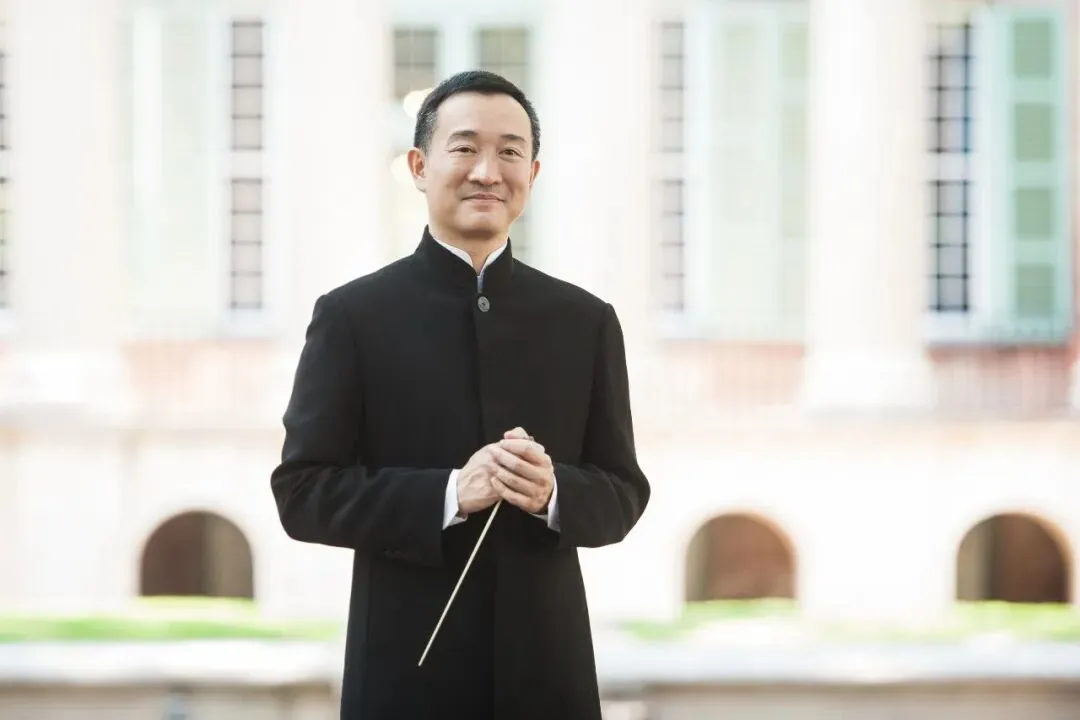
林敬基
KEN LAM
向上滑动阅览
SCROLL UP TO READ
林敬基,现任天津茱莉亚学院管弦乐表演专业总监、天津茱莉亚管弦乐团驻团指挥,同时担任伊利诺伊州交响乐团艺术顾问、北卡罗莱纳州布里瓦德音乐中心驻场指挥以及香港和声艺术总监。
2015至2022年,林敬基任查尔斯顿交响乐团音乐总监;并于2017至2022年,担任伊利诺伊州交响乐团音乐总监。此前,他还担任过巴尔的摩交响乐团教学项目副指挥、辛辛那提交响乐团助理指挥和香港室内乐团首席指挥。
2011年,林敬基荣获孟菲斯国际指挥大赛的冠军,并于2009年在美国交响乐团联盟举办的华尔特指挥预演中指挥纳什维尔交响乐团。2008年,他与另外三位指挥被莱昂纳多·斯拉特金选中,在肯尼迪中心指挥美国国家交响乐团,这是他在美国的正式首演。近年间,他还曾指挥辛辛那提交响乐团、辛辛那提流行管弦乐团和巴尔的摩、底特律、布法罗、孟菲斯、夏威夷、布里瓦德、莫里迪恩等地的交响乐团,以及香港小交响乐团、香港管弦乐团、韩国城南市立交响乐团、贵阳交响乐团和台北市立交响乐团等。
在歌剧方面,他曾为布里瓦德音乐中心珍尼克歌剧院的多个制作执棒,并在辛辛那提歌剧院、巴尔的摩抒情歌剧院和卡斯尔顿音乐节担任助理指挥。近年来,他在美国斯波莱托艺术节、纽约林肯中心艺术节以及多伦多光影艺术节指挥过多部歌剧作品,广受赞誉。2010年,他在皮博迪音乐学院指挥马斯奈的《曼侬》,被《巴尔的摩太阳报》评为华盛顿及巴尔的摩地区十大古典音乐节目。
林敬基曾于美国皮博迪音乐学院跟随古斯塔夫·迈尔和马坎德·塔卡学习指挥、于阿斯本的美国指挥学院随大卫·津曼和穆里·西德林学习,并于美国国家指挥学院随莱昂纳多·斯拉特金学习。在成为职业指挥之前,林敬基在英国剑桥大学圣约翰学院修读经济,并当过十年执业律师,从事国际金融业务。
2015年,美国约翰·霍普金斯大学校友会为林敬基颁发全球成就奖,以表彰他对该校优良传统的传承,并肯定他为学校及其专业领域作出的卓越贡献。
Ken Lam is director of orchestral studies at The Tianjin Juilliard School and resident conductor of the Tianjin Juilliard Orchestra. He is artistic adviser of the Illinois Symphony Orchestra, resident conductor of the Brevard Music Center in North Carolina and serves as artistic director of Hong Kong Voices.
Lam was music director of the Charleston Symphony Orchestra from 2015 to 2022 and music director of Illinois Symphony Orchestra from 2017 to 2022. Previously, Lam also held positions as associate conductor for education of the Baltimore Symphony Orchestra, assistant conductor of the Cincinnati Symphony Orchestra, and principal conductor of the Hong Kong Chamber Orchestra.
In 2011, Lam won the Memphis Symphony Orchestra International Conducting Competition and was a featured conductor in the League of American Orchestra's 2009 Bruno Walter National Conductors Preview with the Nashville Symphony. He made his US professional debut with the National Symphony Orchestra at the Kennedy Center in June 2008, as one of four conductors selected by Leonard Slatkin. In recent seasons, he led performances with the symphony orchestras of Cincinnati and Cincinnati Pops, Baltimore, Detroit, Buffalo, Memphis, Hawaii, Brevard and Meridian, as well as the Hong Kong Sinfonietta, Hong Kong Philharmonic, Seongnam Philharmonic, Guiyang Symphony, and the Taipei Symphony Orchestra.
In opera, he directed numerous productions of the Janiec Opera Company at Brevard and was assistant conductor at Cincinnati Opera, Baltimore Lyric Opera and at the Castleton Festival. In recent seasons, Lam led critically acclaimed productions at the Spoleto Festival USA, Lincoln Center Festival and at the Luminato Festival in Canada. His run of Massenet's Manon at Peabody Conservatory was hailed by the Baltimore Sun as a top ten classical event in the Washington D.C/Baltimore area in 2010.
Lam studied conducting with Gustav Meier and Markand Thakar at Peabody Conservatory, David Zinman and Murry Sidlin at the American Academy of Conducting at Aspen, and Leonard Slatkin at the National Conducting Institute. He read economics at St. John's College, Cambridge University and was an attorney specializing in international finance for ten years before becoming a conductor.
Lam is the 2015 recipient of the John Hopkins University Alumni Association’s Global Achievement Award, given to individuals who exemplify the Johns Hopkins tradition of excellence and have brought credit to the University and their profession in the international arena.
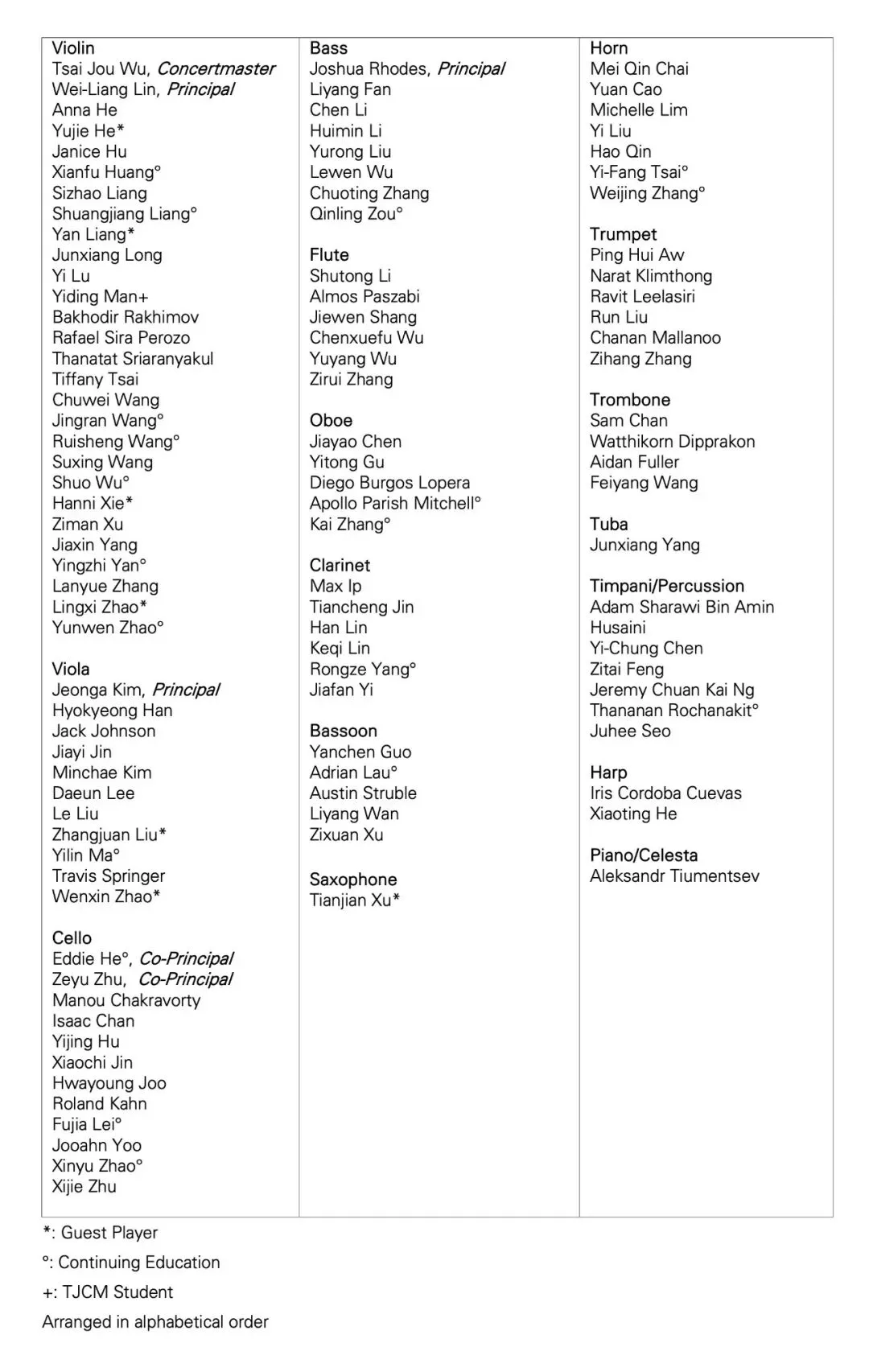
天津茱莉亚管弦乐团
TIANJIN JUILLIARD ORCHESTRA
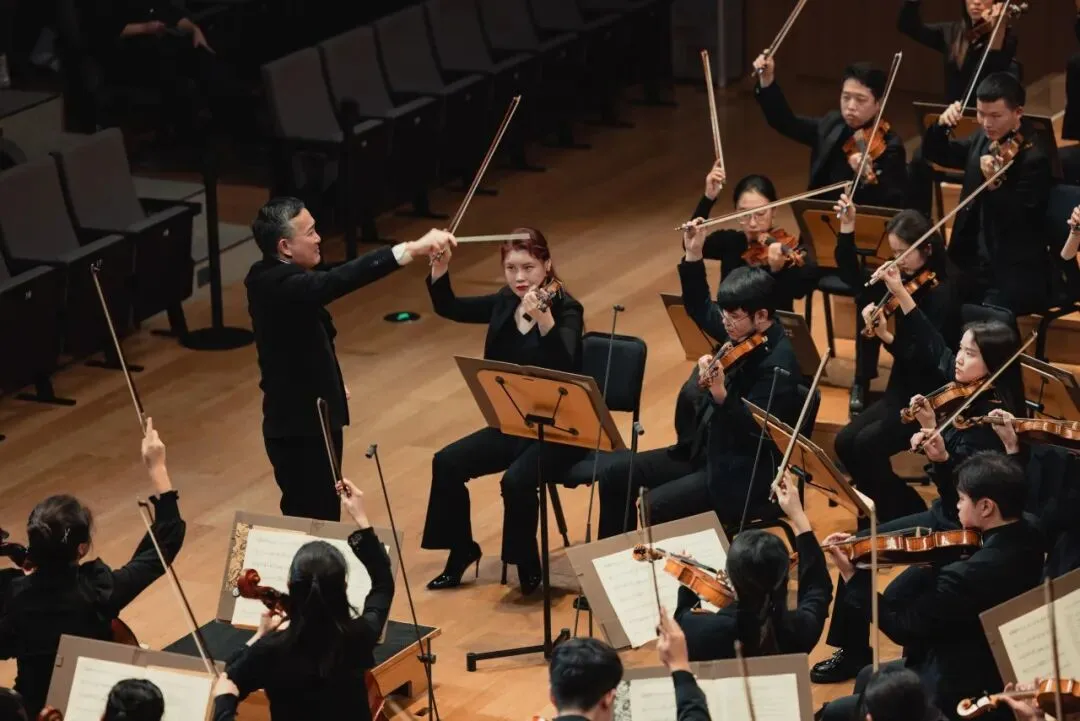
天津茱莉亚管弦乐团在每个音乐季中献上约十场音乐会。从巴洛克时期曲目到当代作品,天津茱莉亚管弦乐团会为我们带来风格丰富的演绎,其中也包含了与中国传统乐器合作演奏的佳作。常驻教师与客座教师将指导乐队声部排练,并与他们一同练习和演出。在驻团指挥带领的音乐会之外,乐团还曾与多位著名的客座指挥合作。
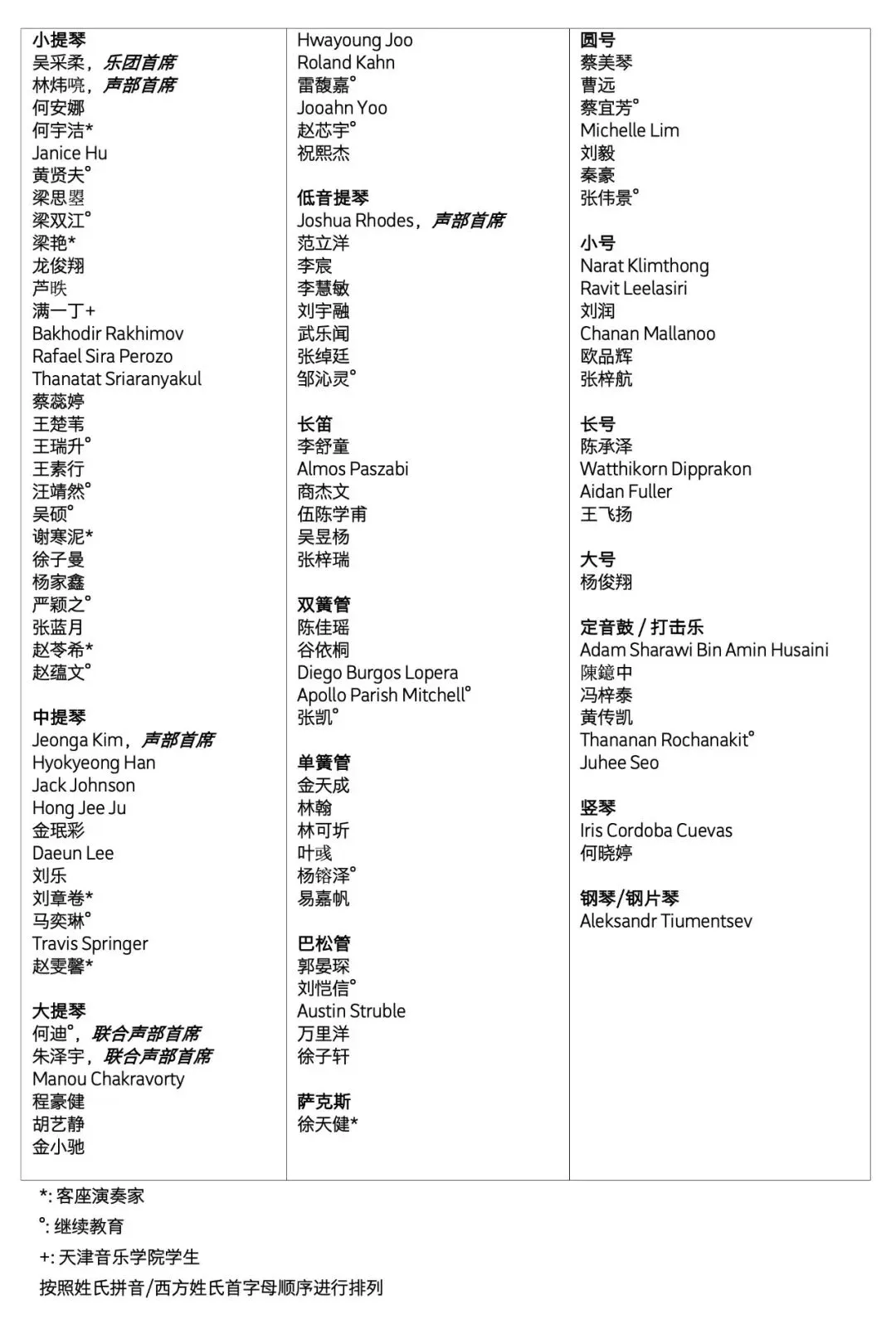
The Tianjin Juilliard Orchestra presents up to 10 concerts each season, performing a diverse repertoire ranging from baroque to contemporary orchestral works, as well as pieces using traditional Chinese instruments. Resident faculty and visiting artists lead discussions, coach sectionals, and play side-by-side with students in rehearsals and performances. In addition to concerts led by the resident conductor, in recent seasons the orchestra also works with renowned guest conductors.